THE SAFETY
OF BRUKINSA
OVERALL INCIDENCE OF ADVERSE REACTIONS (ARs)1,2
| Adverse Reactions1,2 |
ARs in ≥10% of patients with WM (Cohort 1) | Pooled data: ARs in patients with hematologic malignancies |
||||
|---|---|---|---|---|---|---|
| BRUKINSA (n=101) | Ibrutinib (n=98) | BRUKINSA (N=1550)* | ||||
| All Grades (%) | Grades 3 or 4 (%) | All Grades (%) | Grades 3 or 4 (%) | All Grades (%) | Grade ≥3 (%) | |
| Upper respiratory tract infection | 44 | 0 | 40 | 2 | 39 | 2 |
| Pneumonia | 12 | 4 | 26 | 10 | 20 | 11 |
| Urinary tract infection | 11 | 0 | 13 | 2 | 13 | 2 |
| Diarrhea | 22 | 3 | 34 | 2 | 19 | 2 |
| Nausea | 18 | 0 | 13 | 1 | 11 | 0.2 |
| Constipation | 16 | 0 | 7 | 0 | 13 | 0.3 |
| Vomiting | 12 | 0 | 14 | 1 | 7 | 0.3 |
| Fatigue | 31 | 1 | 25 | 1 | 17 | 1 |
| Pyrexia | 16 | 4 | 13 | 2 | 10 | 0.8 |
| Edema peripheral | 12 | 0 | 20 | 0 | 4 | 0.2 |
| Bruising | 20 | 0 | 34 | 0 | 23 | 0.1 |
| Rash | 29 | 0 | 32 | 0 | 28 | 0.9 |
| Pruritus | 11 | 1 | 6 | 0 | 7 | 0.1 |
| Musculoskeletal pain | 45 | 9 | 39 | 1 | 30 | 2 |
| Muscle spasms | 10 | 0 | 28 | 1 | 5 | 0.1 |
| Headache | 18 | 1 | 14 | 1 | 11 | 0.4 |
| Dizziness | 13 | 1 | 12 | 0 | 11 | 0.3 |
| Cough | 16 | 0 | 18 | 0 | 19 | 0.1 |
| Dyspnea | 14 | 0 | 7 | 0 | 8 | 0.5 |
| Hemorrhage | 42 | 4 | 43 | 9 | 30 | 4 |
| Hypertension | 14 | 9 | 19 | 14 | 14 | 7 |
Safety in WM consistent with established BRUKINSA profile across B-cell malignancies1,2
The median follow-up time for Cohort 1 was 19.4 months.3
BRUKINSA had lower rates of:
Hypertension3
- Ibrutinib patients experienced nearly 2-fold higher incidence rate of hypertension on an exposure-adjusted basis (BRUKINSA vs ibrutinib: 0.7% vs 1.2%, respectively)
Major hemorrhage3
- Ibrutinib patients experienced nearly 2-fold higher incidence rate of major hemorrhage on an exposure-adjusted basis (BRUKINSA vs ibrutinib: 0.3% vs 0.6%, respectively)
INCIDENCE OF LABORATORY ABNORMALITIES
Select laboratory abnormalities† (≥20%) that worsened from baseline in Cohort 1
| Laboratory Abnormality1 | BRUKINSA‡ | Ibrutinib‡ | ||
|---|---|---|---|---|
| All Grades (%) | Grades 3 or 4 (%) | All Grades (%) | Grades 3 or 4 (%) | |
| Hematologic abnormalities | ||||
| Neutrophils decreased | 50 | 24 | 34 | 9 |
| Platelets decreased | 35 | 8 | 39 | 5 |
| Hemoglobin decreased | 20 | 7 | 20 | 7 |
| Chemistry abnormalities | ||||
| Bilirubin increased | 12 | 1.0 | 33 | 1.0 |
| Calcium decreased | 27 | 2.0 | 26 | 0 |
| Creatinine increased | 31 | 1.0 | 21 | 1.0 |
| Glucose increased§ | 45 | 2.3 | 33 | 2.3 |
| Potassium increased | 24 | 2.0 | 12 | 0 |
| Urate increased | 16 | 3.2 | 34 | 6 |
| Phosphate decreased | 20 | 3.1 | 18 | 0 |
INCIDENCE OF ATRIAL FIBRILLATION/FLUTTER
| Adverse Event3 |
All Grades n (%) |
Grade ≥3 n (%) |
||
|---|---|---|---|---|
| BRUKINSA (n=101) |
Ibrutinib (n=98) |
BRUKINSA (n=101) |
Ibrutinib (n=98) |
|
| Atrial fibrillation/flutter | 2 (2) | 15 (15) | 0 (0) | 4 (4) |
BRUKINSA HAD LOWER RATES OF:
Atrial fibrillation/flutter2,3
- Ibrutinib patients experienced nearly 10-fold higher incidence of atrial fibrillation/flutter on an exposure-adjusted basis (BRUKINSA vs ibrutinib: 0.1% vs 1.0%, respectively)
- No incidences of Grade ≥3 atrial fibrillation or flutter in patients who received BRUKINSA
LOW RATE OF ATRIAL FIBRILLATION/FLUTTER
AND HYPERTENSION WITH BRUKINSA
Initial analysis (19 months)3
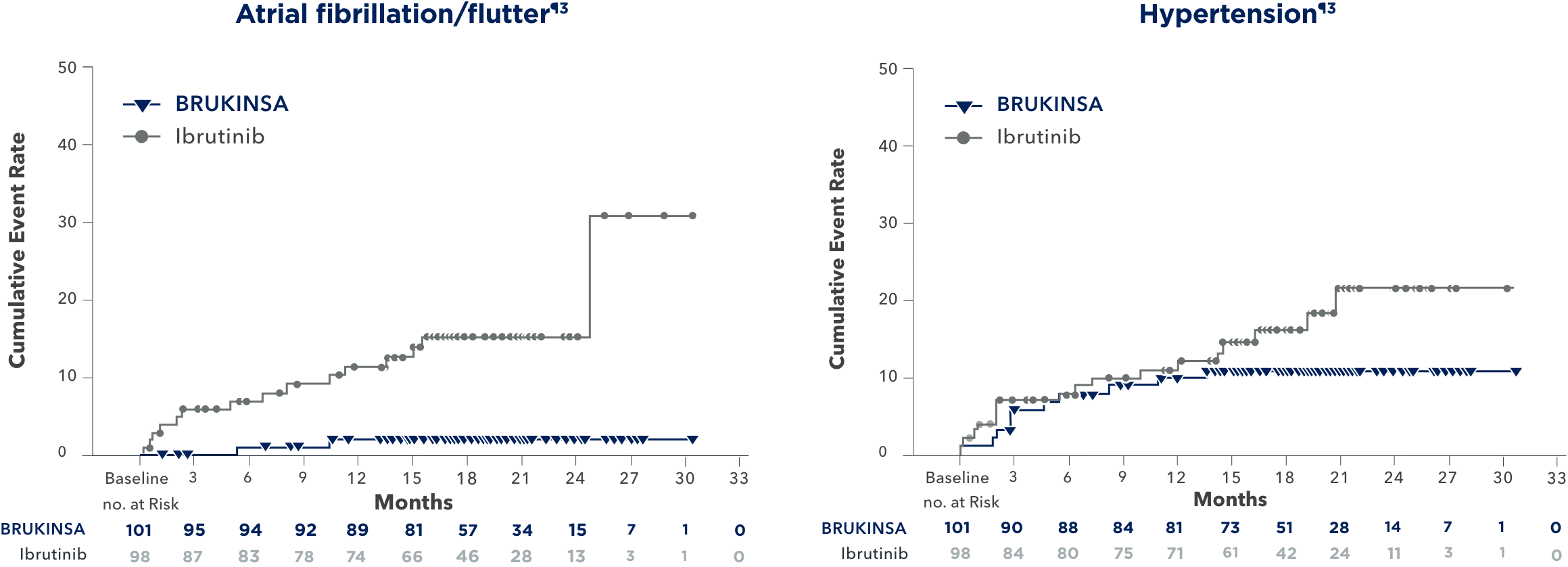
ADVERSE REACTIONS OF INTEREST AND THEIR PREVALENCE OVER TIME4
Long-term analysis (44 months)4

DOSE REDUCTIONS AND DISCONTINUATION RATE
DUE TO ADVERSE EVENTS (AEs) IN ASPEN (STUDY 302)3
Initial analysis (19 months)3
Dose reductions due to AEs
BRUKINSA
Cohort 1 (n=101)
of patients
Ibrutinib
(n=98)
of patients
Discontinuation rate due to AEs
BRUKINSA
Cohort 1 (n=101)
of patients
Ibrutinib
(n=98)
of patients
Median duration of treatment: 25 months2
In a ~4-year follow-up consistent with the primary analysis, fewer AEs leading to treatment discontinuation and dose reductions occurred with BRUKINSA4


References: 1. BRUKINSA. Package insert. BeiGene USA, Inc.; 2025. 2. Data on file. BeiGene USA, Inc. 3. Tam CS, Opat S, D’Sa S, et al. A randomized phase 3 trial of zanubrutinib vs ibrutinib in symptomatic Waldenström macroglobulinemia: the ASPEN study. Blood. 2020;136(18):2038-2050. 4. Tam CS, Garcia-Sanz R, Opat S, et al. ASPEN: long-term follow-up results of a phase 3 randomized trial of zanubrutinib versus ibrutinib in patients with Waldenström macroglobulinemia. Poster presented at: American Society of Clinical Oncology (ASCO) 2022 Annual Meeting; June 3-7, 2022. Abstract 7521.